
Surface Finishing Processes
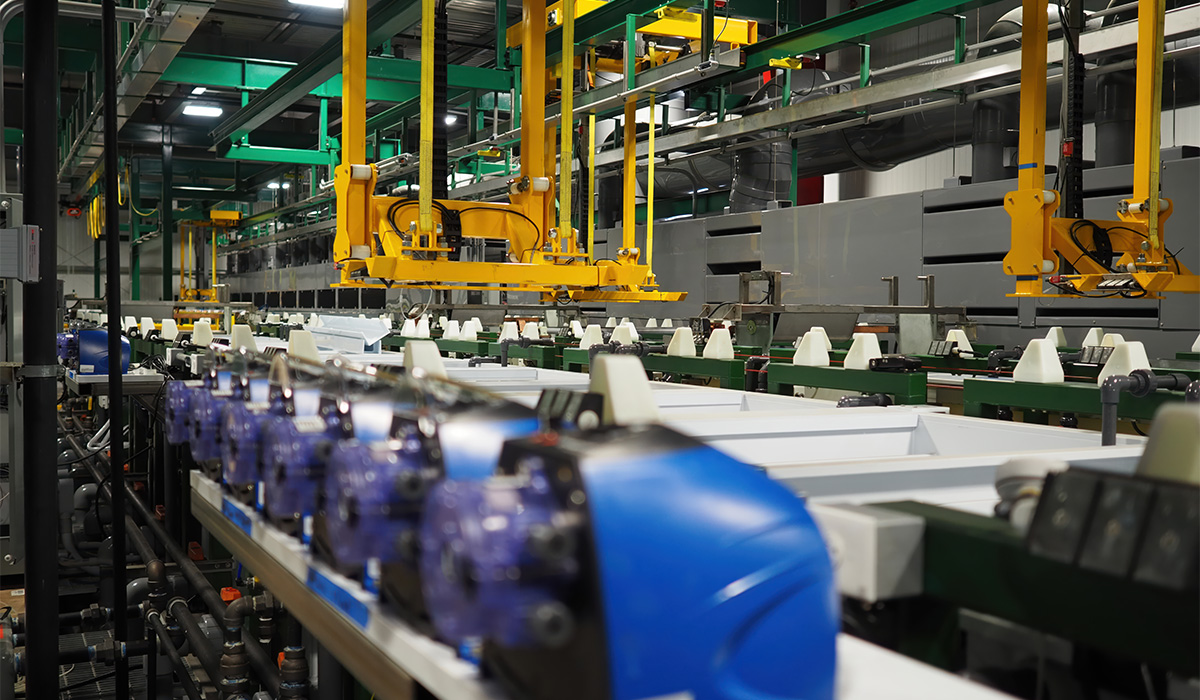

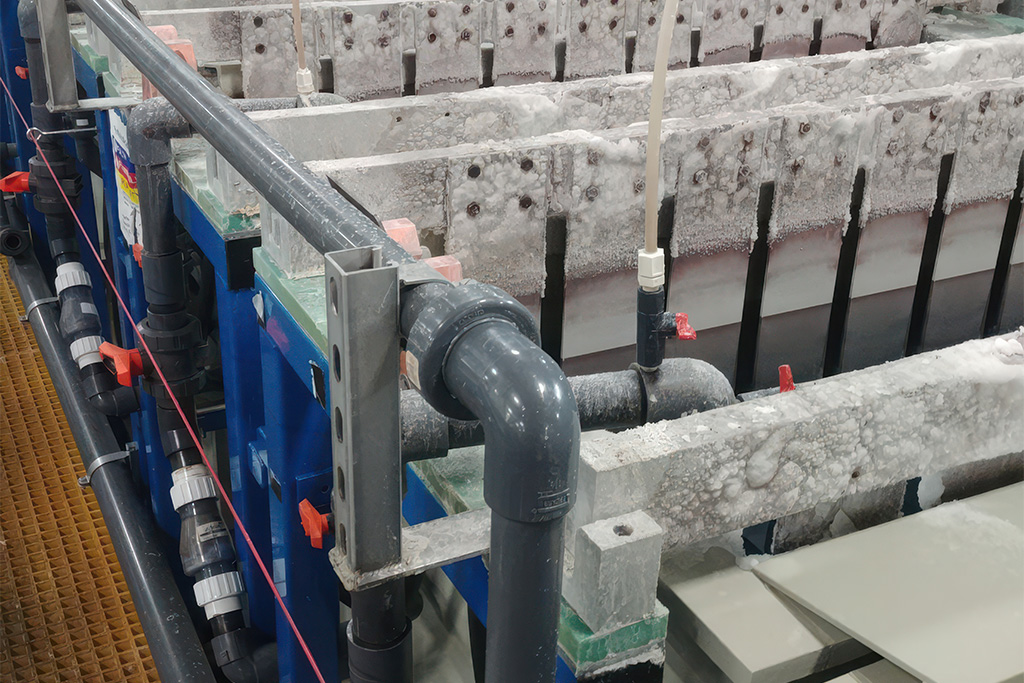
Precision Process helps manufacturers turn complex coating and finishing requirements into practical turnkey equipment solutions. Whether you need to add material, transform a surface, or remove microscopic imperfections, our engineering team develops the system around the result your parts must achieve.
Every finishing operation has unique requirements. We develop application-specific systems that integrate equipment, process controls, material handling, and automation to achieve your finish specifications, production goals, and long-term operating needs.
Develop equipment around your parts, substrates, finish specifications, production goals, floor space, and operating requirements.
Address functional plating, electroless plating, anodizing, electropolishing, and conversion coating applications within the appropriate system scope.
Coordinate process tanks, rinsing, controls, material handling, ventilation, utilities, filtration, temperature control, and supporting equipment.
Design around the variables that affect finish quality, including chemistry, temperature, pH, current, voltage, treatment time, loading, agitation, and rinsing.
Balance finish performance with throughput, maintainability, operator access, safety, and long-term operating needs.
Consider how parts enter, move through, and leave the finishing process to reduce unnecessary handling and bottlenecks.
Match the level of automation to production volume, repeatability goals, part mix, and operator requirements.
Keep engineering, operations, quality, maintenance, safety, and purchasing teams aligned from discovery through implementation.
Select and configure the process around what the finished part must do, not simply what equipment is readily available.
Selecting the right surface finishing process starts with understanding your substrate, part geometry, production requirements, and desired performance. From functional and electroless plating to anodizing, electropolishing, and conversion coating, each process offers distinct advantages for improving durability, corrosion resistance, conductivity, cleanliness, appearance, and overall part performance.
Precious metals are rare elements prized for resisting corrosion and conducting electricity. Gold and silver are essential for functional plating. Gold provides malleability and corrosion resistance for electronics and jewelry, while silver offers superior thermal and electrical conductivity for solar panels, electronics, and silverware.
Functional plating deposits a metal coating primarily to improve part performance. Depending on the coating, it can support wear resistance, corrosion protection, conductivity, solderability, hardness, dimensional restoration, lubricity, or heat resistance. Parts that require a different metal at the surface to achieve a mechanical, electrical, chemical, or dimensional result.
Electroless plating uses a controlled chemical reaction to deposit metal without an external electrical current. It can provide uniform thickness across complex shapes, recesses, threads, blind holes, and selected internal surfaces. Complex geometries, consistent coating thickness, selected nonconductive substrates after activation, and corrosion- or wear-resistant nickel-phosphorus coatings.
Anodizing electrochemically transforms the surface of aluminum and other suitable metals into a controlled oxide layer. The process can improve corrosion resistance, wear resistance, electrical insulation, coating adhesion, and appearance. Aluminum and other suitable metals requiring a durable oxide finish, including Type I, Type II, or Type III anodizing applications.
Conversion coating chemically transforms a thin outer layer of metal into a protective or adhesion-promoting compound. Common categories include phosphate, chromate conversion, and black oxide treatments. Pretreatment, paint adhesion, light corrosion protection, electrical-property control, identification, or cost-sensitive finishing requirements.
Electropolishing removes a controlled amount of metal to smooth, clean, and brighten the surface. It can reduce microscopic roughness and burrs while improving cleanliness and corrosion performance, especially on stainless steel. Hygiene-sensitive, cleanliness-critical, corrosion-resistant, or low-friction surfaces that must be improved without adding a coating.

An aerospace manufacturer needed to improve the corrosion resistance and coating consistency of aluminum components. Its existing finishing operation produced uneven coating thickness and inconsistent coverage, resulting in excessive rework, production delays, and increased quality risks. A custom finishing systems provider collaborated with the manufacturer’s engineering, quality, production, maintenance, and safety teams to evaluate the components, substrate, finish specifications, chemistry, material flow, controls, and facility constraints. The resulting turnkey anodizing system integrated pretreatment, finishing, rinsing, material handling, ventilation, utilities, and process controls within a single project scope. Automated monitoring helped maintain critical variables such as temperature, treatment time, voltage, and chemistry. Following implementation, rework and scrap decreased by 32%, production capacity increased by 25%, and manual handling and processing time decreased by 20%. Components also consistently met approved coating-thickness and corrosion-resistance requirements. According to the aerospace manufacturer’s director of operations, “The new system gave us greater control over finish quality while helping our team increase capacity and reduce rework.”
| EVALUATION FACTOR | PRECISION PROCESS TURNKEY SOLUTION | STANDARD OR OFF-THE-SHELF EQUIPMENT | PATCHWORK OR MULTI-VENDOR APPROACH |
| Application fit | Engineered around the parts, process, specification, production goals, and facility | Limited to available sizes, configurations, and options | Individual components may work but may not function as one coordinated system |
| Process selection | Starts with the surface result and operating requirements | Often starts with the available equipment platform | Each supplier may focus on one part of the process |
| System integration | Tanks, rinses, controls, handling, ventilation, utilities, and support equipment can be coordinated | Additional engineering may be needed for integration | The customer must coordinate interfaces among multiple suppliers |
| Process control | Designed around the variables that influence finish consistency | Standard controls may not match the required process window | Controls may vary across separate equipment packages |
| Customization | Materials, tank sizes, automation, layout, and material flow can be tailored | Customization is usually limited | Changes may require coordination and redesign across vendors |
| Project accountability | One engineering partner helps coordinate the approved turnkey scope | Responsibility may end at equipment supply | Responsibility can be divided among equipment, controls, process, and installation providers |
| Expansion planning | Capacity, part mix, maintenance access, and future needs can be considered during development | Future flexibility depends on the selected platform | Expansion may add more disconnected equipment or controls |
| Best fit | Complex, specialized, integrated, or production-critical finishing applications | Straightforward applications that fit a standard design | Organizations with internal resources to manage multiple specialists and interfaces |
Selecting the right surface finishing process starts with understanding your substrate, part geometry, production requirements, and desired performance. From functional and electroless plating to anodizing, electropolishing, and conversion coating, each process offers distinct advantages for improving durability, corrosion resistance, conductivity, cleanliness, appearance, and overall part performance.
The answer depends on what the finished part must do. Begin with the substrate, geometry, environment, finish specification, required performance, appearance, production volume, acceptable dimensional change, and total operating requirements. Precision Process can help organize these factors into an equipment concept.
This page presents Precision Process as a provider of engineered surface finishing equipment solutions. Any laboratory testing, process development, sample finishing, production services, or chemistry support should be described separately according to the services actually available.
Surface finishing does not operate in a vacuum; plating cells generate complex air emissions, wastewater streams, and strict chemical storage demands that must coordinate seamlessly. Rather than treating utilities as isolated afterthoughts, our engineering methodology unifies wastewater treatment systems, scrubbers, ventilation, and chemical delivery into a cohesive plant-wide architecture from day one, ensuring absolute environmental compliance and smooth facility control.
In some applications, a system may include multiple pretreatment, finishing, rinsing, sealing, or post-treatment stages. Feasibility depends on chemistry compatibility, contamination control, part flow, production mix, ventilation, utilities, and the required process controls.
Yes. Systems can be developed around part geometry, substrate, chemistry, finish requirements, tank size, throughput, material handling, automation, controls, ventilation, filtration, heating, cooling, rinsing, floor space, utilities, and integration requirements. Final capabilities depend on the approved project scope.
Helpful information includes part drawings and dimensions, substrate, finish specification, required performance, annual or hourly volume, load size, current process details, quality concerns, material flow, facility layout, available utilities, wastewater requirements, and target schedule. If some information is unknown, begin with the problem the finish must solve.
Pricing depends on the process, chemistry, system size, materials of construction, number of stages, automation, controls, handling, ventilation, filtration, temperature control, rectification, wastewater interfaces, documentation, testing, installation, and startup support. Precision Process can prepare project-specific pricing after the required scope is defined.
Lead time is affected by process complexity, engineering requirements, system size, automation, component availability, testing, and installation scope. A preliminary schedule can be developed after the main technical and production requirements are understood.
Integration may be possible after reviewing the existing tanks, controls, material handling, ventilation, utilities, layout, capacity, condition, chemistry, and process compatibility.
The appropriate level depends on production volume, part mix, process timing, repeatability, operator availability, traceability, maintenance resources, and budget. The objective is not to automate every action; it is to apply automation where it improves control, safety, capacity, or operating consistency.
Common considerations include water quality, electrical service, heating or cooling, compressed air, ventilation, chemical storage, drainage, wastewater treatment, secondary containment, floor loading, access, material flow, maintenance space, and applicable environmental and worker-safety requirements.
A repeatable system begins with a defined process window and equipment capable of controlling the variables that matter. Depending on the application, those variables may include chemistry, pH, temperature, current, voltage, treatment time, agitation, filtration, loading, transfer time, rinsing, and replenishment.
A Precision Process representative will review the available part, finish, production, and facility information and contact you to discuss the application. Drawings, specifications, process data, and layout information can help accelerate the initial evaluation but are not required for the first conversation.
Whether you are adding a new finishing process, replacing constrained equipment, improving consistency, increasing capacity, or bringing production in-house, Precision Process can help turn your requirements into a practical turnkey system.