
Electroless Plating
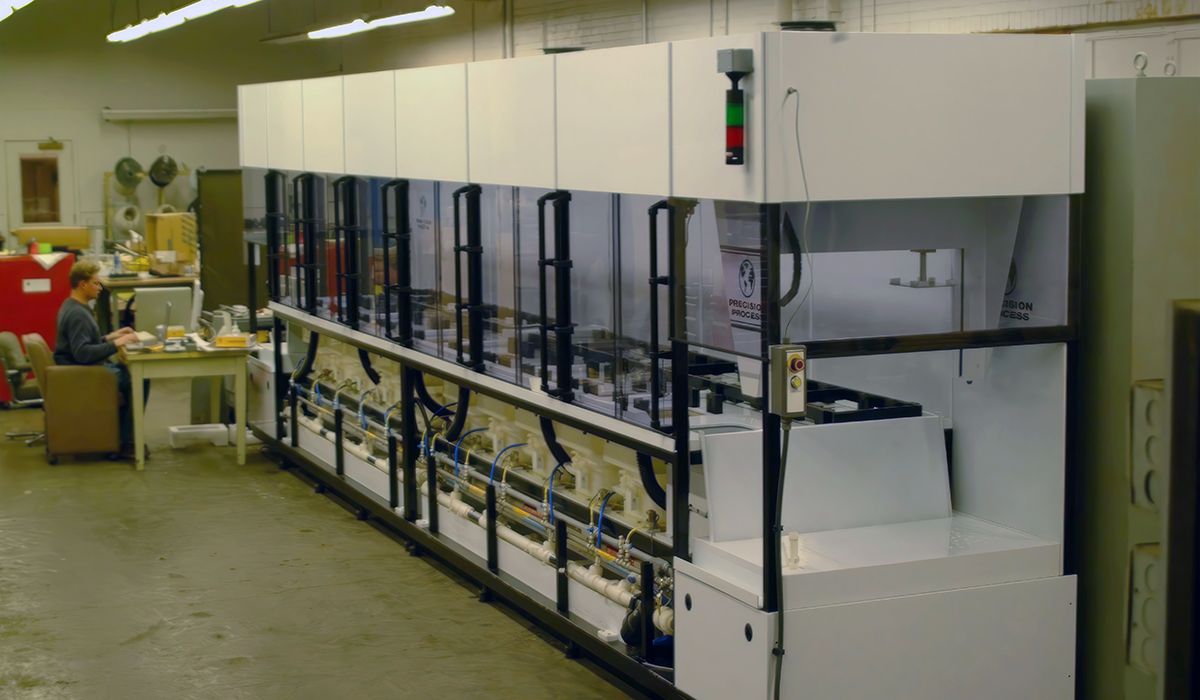

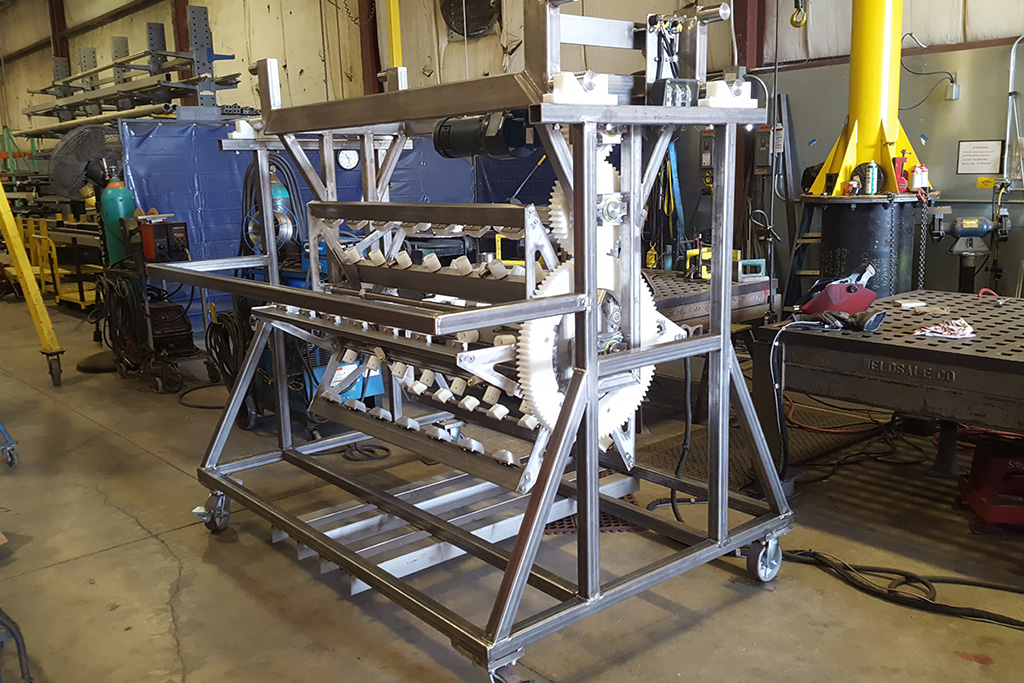
Precision Process helps manufacturers develop equipment for applying functional metal coatings without an external electrical current. Our engineering team turns part, coating, production, and facility requirements into a coordinated turnkey solution designed to improve process consistency and control.
Electroless plating uses a controlled chemical reaction to deposit metal onto a prepared surface. Because the process does not rely on electrical current distribution, it can produce more uniform coating thickness across complex shapes, recesses, threads, blind holes, and internal surfaces.
With the proper surface preparation and activation, the process can also coat nonconductive materials such as plastics, ceramics, glass, and composites. This makes electroless plating valuable when part geometry, substrate material, corrosion protection, wear resistance, or consistent thickness is critical.
Achieve more even coverage across complex shapes and hard-to-reach surfaces.
Coat recesses, threads, blind holes, and selected internal areas more consistently than processes influenced by current distribution.
Apply metal coatings to properly prepared and activated plastics, ceramics, glass, or composites.
Support more uniform hardness, wear resistance, corrosion resistance, and thickness across the part.
Develop equipment around your parts, bath chemistry, production goals, available space, handling needs, and operating requirements.
Coordinate process stages, tanks, controls, material handling, ventilation, utilities, and supporting equipment within one project scope.
Design around the monitoring and control required to maintain bath temperature, chemistry, pH, filtration, replenishment, and useful bath life.
Balance coating performance with throughput, maintenance, operator access, safety, and total operating requirements.
Every successful system begins with a clear understanding of the coating objective and production environment. Precision Process evaluates your parts, substrate, chemistry, specifications, facility constraints, and operational requirements before developing a coordinated equipment concept. From process design and engineering through testing, training, installation, and startup, each stage supports a practical turnkey solution built for consistent, production-ready performance.
We begin with the coating’s purpose, such as improving corrosion resistance, wear resistance, hardness, conductivity, dimensional consistency, or electromagnetic shielding.
Our engineering team reviews the part geometry, substrate, coating specification, production rate, bath chemistry, surface preparation, facility needs, and process constraints.
We map the required cleaning, activation, plating, rinsing, handling, controls, ventilation, and supporting process stages.
Precision Process develops the approved equipment system around the application, operating requirements, and project scope.
Testing, documentation, training, installation, and startup support are coordinated as defined in the final project agreement.

An aerospace manufacturer needed a uniform electroless nickel coating on precision components containing blind holes, threads, and deep recesses. Its existing process produced uneven coating thickness and incomplete coverage, increasing rework and putting quality and delivery requirements at risk.
A custom finishing systems provider worked with the manufacturer’s engineering, quality, and production teams to evaluate the component geometry, substrate, coating specifications, bath requirements, material flow, and facility constraints. The resulting turnkey system integrated surface preparation, activation, plating, rinsing, material handling, and process controls around the application.
Following implementation, the manufacturer achieved more consistent coating thickness across difficult-to-reach surfaces, reduced rework, and improved production reliability. The finished components consistently met established coating and corrosion-resistance requirements, giving the aerospace quality manager greater confidence in the process and its ability to support future demand.
Quality Manager, Aerospace Manufacturing
| EVALUATION FACTOR | PRECISION PROCESS TURNKEY SYSTEM | STANDARD EQUIPMENT | TRADITIONAL APPROACH |
| System fit | Engineered around the application, parts, chemistry, production goals, and facility | Limited to available sizes, configurations, and options | Must also account for current distribution and electrical contact |
| Coverage on complex shapes | Designed to support uniform chemical deposition across difficult geometries | Performance depends on how well the standard design fits the process | Thickness can vary with geometry and current density |
| Nonconductive substrates | Can support properly activated plastics, ceramics, glass, and composites | Capability depends on system design and pretreatment stages | Substrates generally require a conductive surface before plating |
| Process integration | Pretreatment, plating, rinsing, handling, controls, and supporting equipment can be coordinated | Additional vendors or engineering may be required | Requires rectifiers, electrical contacts, and related controls |
| Bath management | Monitoring, heating, filtration, replenishment, and control needs can be designed into the system | Standard controls may not match the chemistry or production requirement | Bath control is still required, but deposition is electrically driven |
| Project coordination | One engineering partner helps coordinate the approved turnkey scope | The customer may need to manage multiple suppliers | Equipment, power, racking, and process integration may involve separate specialists |
| Best fit | Specialized, complex, or production-critical electroless plating applications | Straightforward applications that fit a standard configuration | Applications where deposition speed, selective coating, or conventional electroplating economics are the priority |
Electroless plating deposits metal onto a prepared surface through a controlled chemical reaction. Unlike traditional electroplating, it does not use an external electrical current to drive the deposition.
Its primary advantage is uniform coating thickness across complex shapes. Because deposition does not depend on current density, the process can coat recesses, threads, blind holes, and internal surfaces more evenly.
Electroless plating can be used on many metals and, after proper preparation and activation, nonconductive materials such as plastics, ceramics, glass, and composites. Suitability depends on the substrate, coating specification, pretreatment process, and intended use.
Electroless nickel is the most common option, including nickel-phosphorus coatings. Other electroless metal and alloy processes may be possible depending on the application and validated process chemistry.
Yes. The system can be developed around part geometry, substrate, coating chemistry, throughput, tank size, material handling, controls, ventilation, filtration, heating, rinsing, floor space, utilities, and integration requirements. Final capabilities depend on the approved project scope.
Useful information includes part drawings and dimensions, substrate material, coating type, thickness range, performance specification, annual or hourly volume, expected loading, current process details, quality concerns, facility layout, available utilities, and target schedule. If some details are unknown, begin with the problem the coating must solve.
Cost depends on system capacity, chemistry, tank materials, process stages, automation, controls, handling, ventilation, filtration, heating, wastewater requirements, documentation, testing, installation, and startup support. Precision Process can develop project-specific pricing after reviewing the required scope.
Lead time is affected by application complexity, engineering requirements, system size, automation, component availability, testing, and installation scope. A preliminary schedule can be developed after the core technical and production requirements are defined.
It can have higher chemical and bath-management costs and a slower deposition rate. However, it may provide better value when uniform thickness, coverage of complex features, coating of nonconductive materials, or consistent properties reduce rework and solve problems that electroplating cannot address effectively.
Stable operation requires control of temperature, pH, metal-ion concentration, reducing-agent concentration, contamination, filtration, loading, replenishment, and bath age. The equipment and controls should be designed around the validated chemistry and process window.
Common applications include electronics and circuit boards, oil and gas components, aerospace and automotive parts, molds and dies, and plastic components requiring a metal surface or electromagnetic shielding.
A Precision Process representative will review the available part, coating, production, and facility information and contact you to discuss the application. Providing drawings, specifications, or current process data can help accelerate the initial evaluation.
Whether you are introducing electroless plating, replacing an inconsistent process, coating more complex parts, or preparing for additional production, Precision Process can help translate your requirements into a practical turnkey equipment solution.